
In this report:
Building on our legacy: a message from the dean
Our students turn curiosity into impact
Our world-class faculty recognized for cutting-edge scholarship and design
Visiting professors bridge practice and academia
CED alums are shaping the future of design and the built environment
We embrace UC Berkeley’s public mission of enhancing society and the greater good
Research and design address complex societal and environmental issues
Philanthropy and partnerships vital to CED’s mission and vision
Building on our legacy: a message from the dean
Thanks to the generosity of our community of donors and supporters, the College of Environmental Design continues to be a leader in environmental design research and education. In this report I am pleased to share with you some highlights of the 2025–2026 academic year.
CED was founded in 1959, and we moved into our current building in 1964. As we enter our 67th year, we are at a crossroads in our disciplinary fields, in a world being altered before our eyes. The climate and weather have ever-increasing impacts on how we build and plan; artificial intelligence tools and agents are changing how faculty and students conduct their research and their learning; migration and displacement across the globe affect how we can and should think about planning, designing, and building; and the list continues. UC Berkeley has always stood at the crossroads of social, economic, and technological change, and our current time is no exception. But the pace of change has accelerated.
CED’s public purpose and mission have never seemed more salient and urgent. Reinvesting in our mission, our research, our education, and our physical plant are critical. Our faculty, students, and staff are capable, resilient, and committed to thinking about and addressing these mounting challenges. One effort in this direction is to redouble our efforts to connect our alums to our college to strengthen a community of practice, of intellectual endeavor, and of human connection. This is what our disciplines are largely about: strengthening the spaces, both private and public, that enable physical proximity, that integrate people’s experiences with other people’s experiences. What we do enriches people’s lives, strengthens our civic engagement and pride, teaches us how to tolerate one another, and teaches us to live with and share goals with each other.
“Our responsibility is not simply to preserve what has made the college exceptional. It is to build on that legacy.”
As we look toward the next chapter, our responsibility is not simply to preserve what has made this college exceptional. It is to build on that legacy — to deepen our commitment to design excellence, accelerate research and innovation, expand opportunity, and ensure that environmental design remains a force for the public good. I am deeply grateful to everyone who makes this work possible. To our donors, partners, and friends, thank you for investing in our people and in the ideas that will shape the future.
Daniel G. Chatman BA ’91
Interim William. W. Wurster Dean
CED has been ranked the #1 public university in the U.S. for architecture and the built environment for 12 consecutive years in the QS World University Rankings
Our students turn curiosity into impact

Design Excellence Award in Architecture
Swen Yuan (MArch ’27), Studio 201A, Instructor: Professor René Davids. The project rethinks three existing buildings along University Avenue in Berkeley by introducing an elevated residential complex that spans above them. The proposal is structured around a multiple-layer landscape facade, developed through an encompassing scaffolding framework that transforms the building envelope into a spatial system of circulation, vegetation, and social interaction.

Arcus Fellow Aims to Tackle Housing Affordability
Arcus Fellow Gyasi Pigott (MCP ’27) came to Berkeley after working as an affordable housing fellow in San Mateo County and as a fellow at the Greenlining Institute, where he worked to ban highway expansions and bring resiliency planning into transportation development. The Arcus Fellowship enables him to further his studies on walkable communities, public transportation, urban agriculture, and affordable housing as approaches to improving the lives of historically marginalized groups.

Cal Team Wins Golden Shovel
Congratulations to Team Cal on winning the 37th Annual NAIOP San Francisco Bay Area Real Estate Challenge against Stanford. The team included UC Berkeley’s Abbey Master of Real Estate Development + Design program students Brian Krall and Isabella Tangherlini. The winning project was a proposal to reimagine Fisherman’s Wharf at the SFMTA Kirkland Yard.
Our world-class faculty recognized for cutting-edge scholarship and design
Through pioneering research, creative practice, teaching, and public engagement, CED faculty address complex challenges, from climate change and housing to equity and urban transformation, while inspiring the next generation of designers, planners, and leaders.
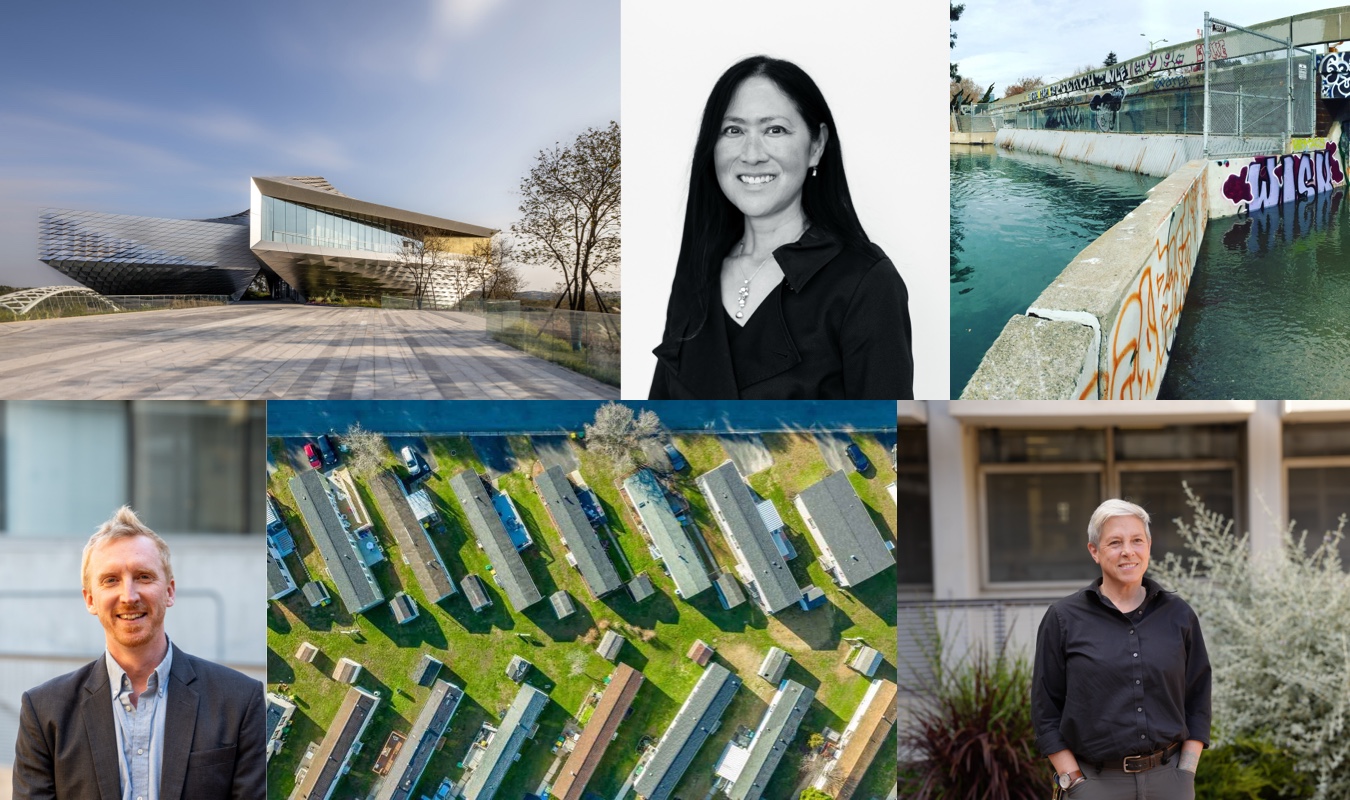
Clockwise from top left: IwamotoScott, Chengdu Pavilion, Sichuan Province, China, 2025; Professor Lisa Iwamoto; high tide at Lake Merritt tide gates in Oakland; Assistant Professor Zachary Lamb; manufactured housing park, California; Professor Kristina Hill
Chair and Professor of Architecture Lisa Iwamoto’s firm, IwamotoScott, won the Architizer 2026 Award for its Chengdu Pavilion and was recognized as one of thetop 100 architecture firms in the U.S.
In a paper published recently in the Journal of the American Planning Association, Assistant Professor of City & Regional Planning Zachary Lamb and his co-authors assess the spatial characteristics of manufactured home parks in the Bay Area to find out if, counter-intuitively, they could be examples of “good urbanism.” Though often derided and rarely studied, manufactured home parks are a significant source of affordable housing in the United States.
Professor of Landscape Architecture & Environmental Planning and Urban Design Kristina Hill was awarded the Landscape Architecture Foundation Medal for distinguished work applying principles of sustainability to landscapes. A researcher, educator, community leader, and advocate working at the intersection of urban design, ecology, and social justice, Professor Hill is a leading expert on how cities can adapt to rising sea levels and rising groundwater due to climate change.
Ben Metcalf, Managing Director, Terner Center for Housing Innovation; Research Professor, City & Regional Planning; Advisor, MRED+D Affordable Housing Concentration, explains Affordable Housing in 101 Seconds.
Over the past five years, 18 new professors have joined CED, and we have built a critical mass of outstanding research and design faculty in areas including spatial artificial intelligence, computational design, regenerative architecture, biomaterials, emerging low-carbon construction technologies, remote infrastructure sensing and detection, and environmental justice.
Partnerships with donors advance the work of CED designers and researchers and allow us to continue recruiting and retaining the best faculty, who have shaped generations of practitioners and researchers across the environmental design disciplines. Highlights of faculty work this past year include an Alumni & Parents Weekend at Homecoming presentation,“Artificial Intelligence and the Future of Environmental Design,” by Maryam Hosseini, assistant professor of city and regional planning, and Kyle Steinfeld, professor of architecture. Jason Corburn, professor of city and regional planning, published a new book, Advancing Peace, a groundbreaking study of how communities around the country are preventing gun violence and supporting the healing of those impacted by violence. And Paul Mayencourt, assistant professor in the architecture department, is conducting mass timber research that aims to accelerate the decarbonization of California’s construction industry.
Visiting professors bridge practice and academia
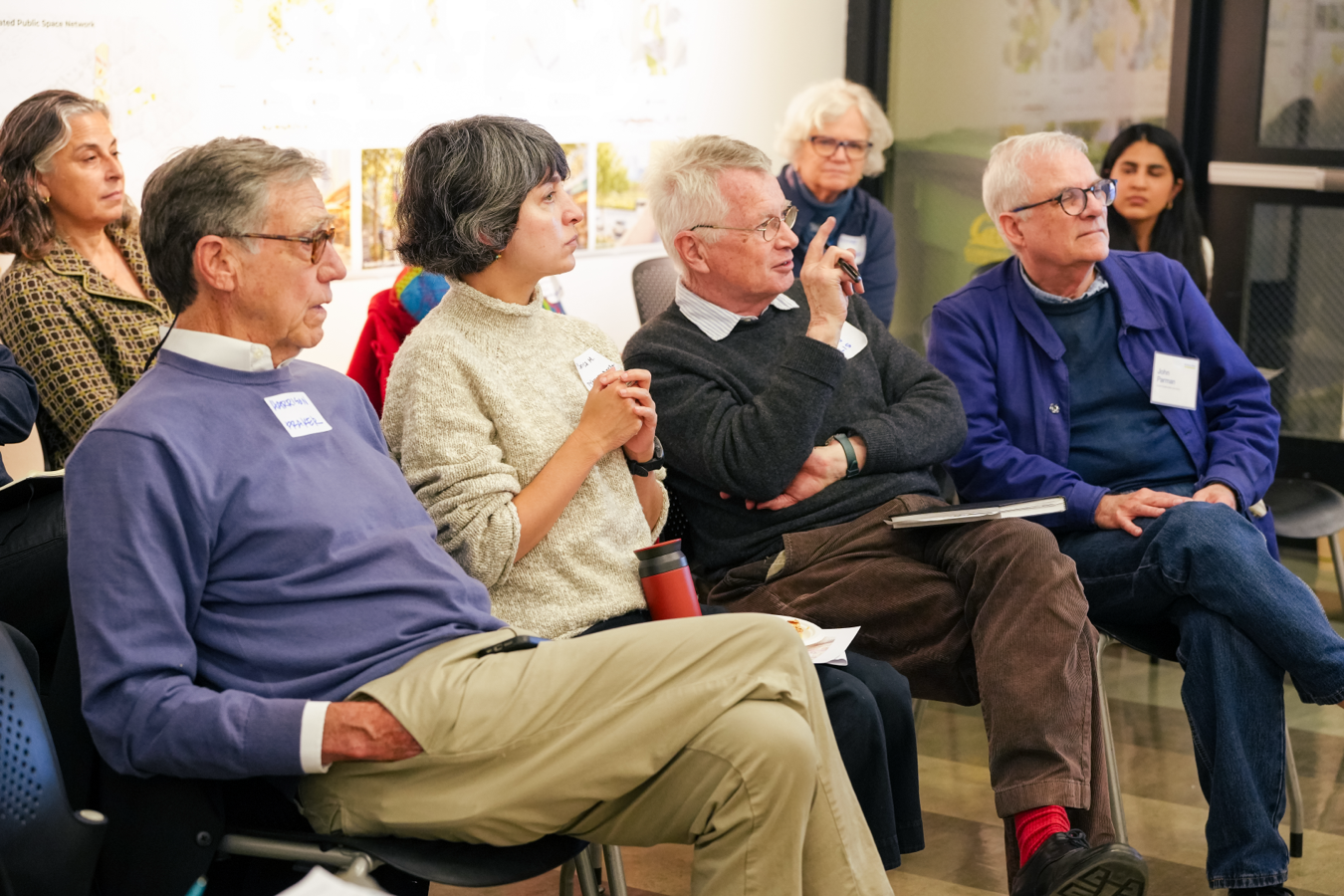
Guest critics at a Master of Urban Design review
CED’s visiting faculty and endowed professors bring new perspectives to our community through teaching, participating in the intellectual and creative life of the college, and giving public lectures. Hosting visitors from around the globe broadens our horizons and leads to innovative, cross-disciplinary solutions to design and planning problems. They connect the college to the worlds of practice, government, nonprofits, and other universities, and help forge a broad coalition committed to creating better futures through the built environment.
- Esherick Endowed Professorship: Byron Kuth, FAIA, and Liz Ranieri, FAIA, Kuth Ranieri Architects
- Friedman Visiting Professorship: Li Hu & Huang Wenjing, OPEN Architecture; Thomas Robinson, FAIA, (BA 1991), Lever Architecture
- JW&VL Professor of Practice: Lawrence Scarpa, Brooks + Scarpa
- Lifchez Professor of Practice in Social Justice: Anya Domlesky, SWA Group
- Robert S. Cornish Endowed Chair of Regional Planning: AJ Kim
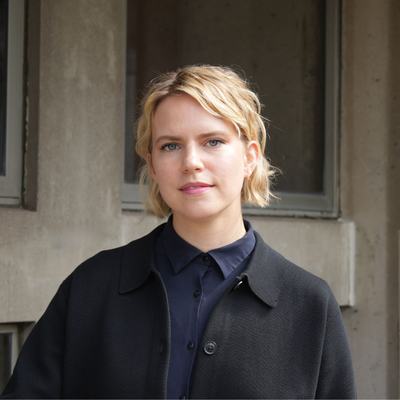
Inaugural Creedon Fellow: Julie Riley
The Creedon Fellowship was endowed by Gerard “Roddy” Creedon (1959–2021), a founder and principal of Allied Architecture + Design and a longtime and beloved lecturer in architecture. It aims to connect academia to practice by bringing an early career designer to teach in the department for a full academic year. The fellowship fund established through Creedon’s legacy endowment was augmented by generous contributions made in Roddy’s memory by CED faculty, alums, and community members. We extend our gratitude to all of the supporters who made this fellowship possible.
CED alums are shaping the future of design and the built environment
Our alums carry forward the values of CED, impacting their communities for the better. Their continued commitment to giving back strengthens the college and helps ensure that future generations of students can learn, lead, and shape the world. CED values its global community of 26,740 alums.

CED 2026 Distinguished Alumni Award Winners
Four alums received the Distinguished Alumni Award at CED’s 2026 Commencement ceremony on May 19 at the Greek Theatre: Alma Du Solier (MLA ’99), Rossana Hu, Hon. FAIA (BA Architecture ’90), Lyndon Neri, Hon. FAIA (BA Architecture ’87), and Greg W. Perloff (MCP ’76). These alums have exhibited outstanding public service, in its broadest sense, throughout their careers.

Walter Hood (MArch `89, MLA `89) Has Been Named to the TIME100
Professor Emeritus of Landscape Architecture & Environmental Planning Walter Hood was named one of Time magazine’s 100 most influential people in the world. In her tribute, landscape architect Kate Orff writes, “Whether he’s riffing off of the intertwined practices of landscape architecture, sculpture, and cultural anthropology, or crafting community parks in his native Oakland, Calif., his work allows us all to take part in a wider civic conversation.”

Sally Librera (MCP ’04)
is using her expertise in public infrastructure, urban spaces, and economic opportunity to lead National Grid, one of the largest energy companies in the nation.

MArch Class of ’76 Celebrated 50 years
Members of the MArch class of 1976 and friends self-organized a visit to Bauer Wurster Hall to mark 50 years. From left: Steve Davies (MArch ’76), Sam Dyer (MArch ’76), Barbara Maloney (MArch ’77), Jonathan Cohen (BA Architecture ’70; MArch ’76), Allison Williams (MArch ’76), Bonnie Blake-Drucker (MArch ’76), Lucia Howard (MArch ’77), Tomas Frank (MArch ’76), Jared Polsky (MArch ’77), Barbara Dyer.
CED Alums Recognized Leaders in the Field
We are proud to highlight accomplishments and recognitions:
American Institute of Architects (AIA) Fellows: Rossana Hu (BA Architecture ’90), Mary Ruppenthal (MArch ’99), and Bryan Young (BA Architecture ’97) were elevated to the 2026 class of the AIA Fellows. The FAIA honor is awarded to architects who have achieved a standard of excellence in the profession and made a significant contribution to architecture and society on a national level.
Oberlander Prize Laureate: Mario Schjetnan (MLA ’70) and his practice Grupo de Diseño Urbano were recipients of the 2025 Oberlander Prize Laureate.
Wallpaper* US400 | Eight CED alums shaping the creative landscape: Benjamin Gilmartin (BA Architecture ’92), Michael Chen (BA Architecture ’96), David Godshall (MLA ’10), Walter Hood (MLA + MArch ’89), James Leng and Jennifer Ly (BA Architecture ’07), Christopher Leong (BA Architecture ’00), Elizabeth Roberts (BA Architecture ’95).
We embrace UC Berkeley’s public mission of enhancing society and the greater good

MLA Students Share Fire-safe Landscape Designs with Berkeley Residents
Master of Landscape Architecture students presented fire-safe designs to residents of the Berkeley Hills, highlighting key strategies for adapting to new regulations without sacrificing aesthetic appeal.

Terner Center Hosts California Gubernatorial Candidates Housing Forum
The Terner Center for Housing Innovation, The New York Times, San Francisco Foundation, and Housing Action Coalition hosted a live, nonpartisan forum in which leading candidates in California’s 2026 gubernatorial race discussed the state’s housing crisis.

Master of City Planning Students Pave the Way for Oxford Street Improvements
The City of Berkeley greenlights a street redesign based on the work of Master of City Planning students, continuing the College of Environmental Design’s tradition of making tangible impacts in our community.

Sustainable Environmental Design Students Are Designing California’s Resilient Future
Undergraduates in UC Berkeley’s sustainable environmental design (SED) program are tackling real-world climate, housing, and equity challenges in direct partnership with the California Governor’s Office.
Research and design address complex societal and environmental issues
CED is one of the world’s most distinguished laboratories for experimentation, research, and intellectual synergy. Our research centers and academic departments pioneered an integrated approach to analyzing, understanding, and designing our built environment that continues to this day. Our goal is to strengthen the college’s reputation as a leader in all aspects of environmental design by accelerating faculty work through philanthropic, governmental, and industry partnerships.

Climate Solutions
Faculty throughout the college’s departments and research centers pursue meaningful climate solutions, from wetland restoration to adapting neighborhoods to sea level rise to innovating carbon-neutral building methods. Issues of adaptability, resilience, and mitigation are at the forefront of our curriculum.

Equity & Social Justice
As disparities and inequities widen, the College of Environmental Design is committed to practices that empower those who often have the least voice. We engage with neighboring communities, public agencies, nonprofits, industry, and government to advance environmental design as a vehicle for equity and social justice.

Technology & Materials Innovation
From AI and remote sensing tools to 3D printing and mass timber, technological innovations are changing the ways we analyze, design, and craft the built environment. Our college is at the forefront of leveraging these new materials and technologies to confront the climate crisis and inequities in our built environment.
Design Excellence
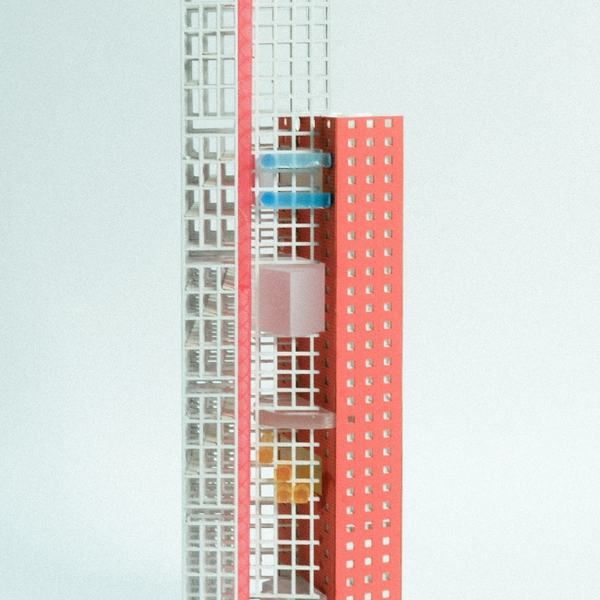
CED research fuels design excellence. Our commitment to design as inquiry, where every design proposition, from its inception, is rooted in purpose and impact. This is how we cultivate the future visionaries and problem-solvers that the world urgently needs.
Stefano Schiavon was appointed inaugural associate dean for research and design at CED. This newly established position aims to solidify the college’s reputation as a leader in all aspects of environmental design by accelerating faculty work through philanthropic, governmental, and industry partnerships.
Student Research: Emma Lasky, PhD candidate in landscape architecture and environmental planning, discusses her multidisciplinary research on how climate change-induced groundwater rise presents urgent challenges for public health and environmental policy.
“CED’s growing research portfolio demonstrates enormous potential to make a meaningful impact on some of society’s most significant challenges. Through seed grants and other sources that advance research, our faculty are building innovative interdisciplinary collaborations and positioning their work to secure transformational federal funding. These investments enable CED to bring the full breadth of environmental design disciplines together to address complex issues that no single field can solve alone.”
— Daniel G. Chatman, Interim William W. Wurster Dean
Philanthropy and partnerships vital to CED’s mission and vision
CED’s advancement is only made possible thanks to generous supporters. Because of their commitment, CED is able to continue its legacy of excellence across disciplines and fulfill its vision to launch our graduates to be agents of change for environmental good.
Arcus Fellows
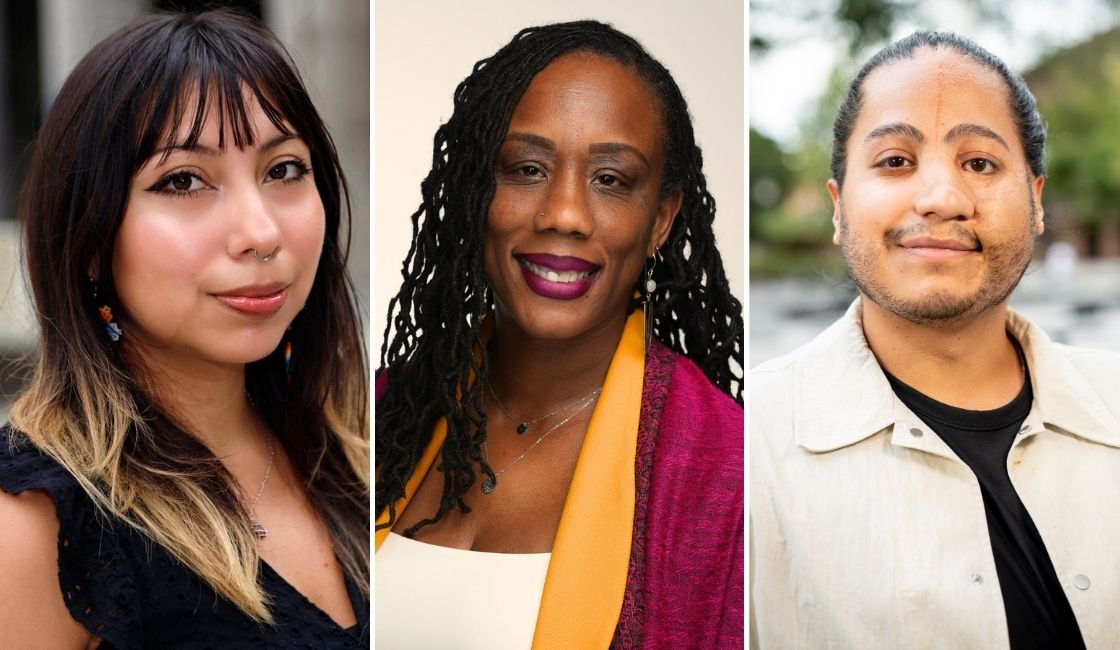
The Arcus Social Justice Corps Fellowship seeks to attract incoming graduate students who have the most potential to make direct and transformational social change in the world through planning, research, and design. The Arcus Fellowship offers free tuition and a basic needs stipend, plus community building and professional networking to students enrolled in any of our master’s degree programs. Arcus Fellows are required to work for three years in a social justice profession following graduate school. Meet three Arcus Fellows — Rashida Chase (MRED+D ’24), Elizabeth Garcia (MLA ’27), and Sam Rodriguez (MArch + MCP ’26) — who are using design, planning, and research to impact communities.

Alum Karen Conway Funds Design Innovation
CED received a $1 million gift to sustain the college’s leadership in design from alum Karen Swett Conway (BA Architecture ’82). The Design Futures fund and endowment aim to position CED at the forefront of creative new modes of design practice and teaching.

Tech Access Initiative Levels the Playing Field for Undergraduates
Since 2021, the Technology Access Initiative has removed barriers to provide equitable access to state-of-the-art software, computer labs, fabrication labs, and digital fabrication labs that are essential to students’ environmental design experience. This initiative helps ensure that talent, creativity, and determination, not circumstance, define a student’s experience at CED. Alums and donors raised $102,000 during Big Give 2026 to support this initiative.

“We Need Great Builders for our Future”
Rachel Vineberg Jones (MArch ’19) and her husband, Eric Jones, have made a generous commitment to CED to increase access to design education for North Bay high school students.
Gift in memory of David A. Sandahl supports MArch students
A recent gift in memory of David A. Sandahl (BArch ’67) provides full graduation tuition support to a Master of Architecture student. Due to changes in federal loans, graduate students pursuing architecture have significantly reduced access to student loans. Graduate funding is a game-changer. When we can offer competitive packages, it increases our yield and transforms the experience of our graduate student body. Time and time again, students talk about the impact of their fellowship funding and how it has shaped their experience. Over time, that investment helps produce architects and designers better prepared to tackle the challenges of the built environment.