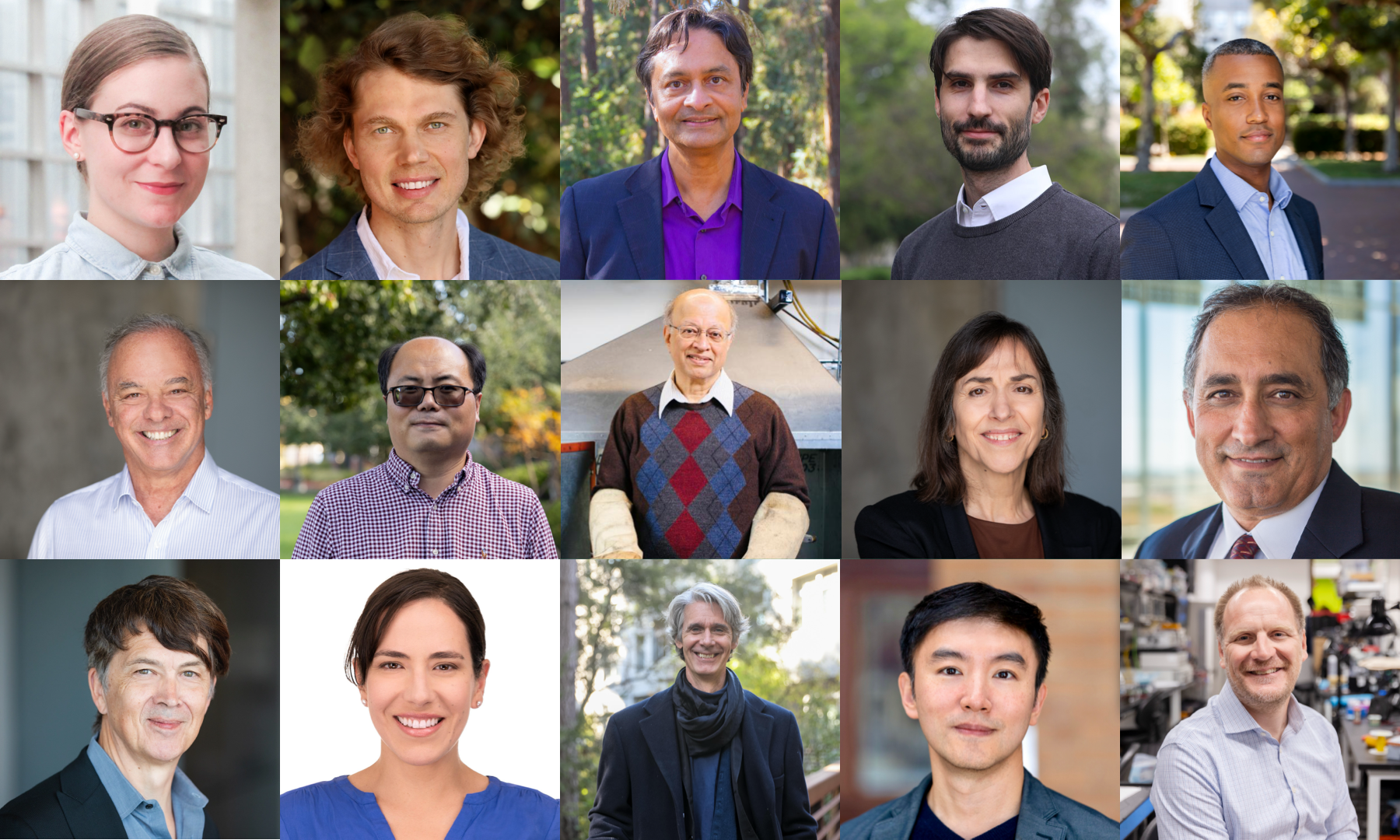
Current faculty recipients of AIC-Bakar Fellows and CITRIS-CDSS Innovation Fellowship and AIC Awards. From top to bottom, left to right: Sarah Chasins, Greg Tikhomirov, M. Saif Islam, Claudio Hail, Zakaria Al Balushi, Paulo Monteiro, Zhaodan Kong, Ashok Gadgil, Roya Maboudian, Reza Ehsani, Gerbrand Ceder, Markita Landry, Theodore Holman, Xiaoyu (Rayne) Zheng, Robert Pilawa-Podgurski.
A transformational $13.5 million commitment from longtime UC Berkeley supporters Matt and Lisa Sonsini will dramatically expand the university’s capacity to translate cutting-edge academic research into ventures that address society’s most pressing challenges.
The commitment launches the next chapter of a partnership with Berkeley that began in 2023, when the Academic Innovation Catalyst (AIC) was founded with a simple but ambitious idea: to help more of Berkeley’s most promising scientific discoveries find their way out of the lab and into the world with targeted proof-of-concept grants and intensive, hands-on commercialization support. Combined with program support provided to date, AIC funding will exceed $16 million.
The expansion of AIC will fund more faculty researchers seeking to commercialize breakthroughs in deep tech areas such as energy, materials science, chemistry, aerospace and mobility, advanced electronics, quantum computing, and AI. AIC will significantly expand the funding pipeline that has powered the partnership to date, supporting two new AIC-Bakar Fellows awards each year and five CITRIS-CDSS Innovation Fellowships annually for the next five years.
“This commitment deepens a partnership that has become a model for how private philanthropy amplifies the public mission of a great research university. With this gift, more of our faculty will have the resources, the mentorship, and the runway to ensure that their discoveries advance knowledge and benefit people all over the globe.”
—Rich Lyons, Chancellor
It also launches an ambitious new endeavor: the Advanced Technologies Entrepreneurial Center (ATEC), housed within the Office of the Chief Innovation and Entrepreneurship Officer. Modeled on a “venture studio” approach, ATEC will provide academic innovators ready to launch a new company with hands-on, end-to-end support, including help building teams, recruiting CEOs, navigating legal and business questions, and connecting with investors. A new fellowship program for graduate students will identify promising research with commercial potential, and a robust mentoring and matchmaking platform will connect faculty with entrepreneurs-in-residence and industry partners. Founders accepted into ATEC will not be required to pay or give up equity for this support. In addition, AIC may coordinate pre-seed financing on founder favorable terms to jumpstart company formation.
“Matt and Lisa have an extraordinary understanding of what it takes to move a brilliant idea from a Berkeley lab into the world, and their generosity has already changed lives,” said Chancellor Rich Lyons. “This commitment deepens a partnership that has become a model for how private philanthropy amplifies the public mission of a great research university. With this gift, more of our faculty will have the resources, the mentorship, and the runway to ensure that their discoveries advance knowledge and benefit people all over the globe.”
A partnership already producing breakthroughs
The new commitment builds on a relationship that has supported researchers across the four CITRIS campuses (UC Berkeley, UC Davis, UC Merced, and UC Santa Cruz) and six Berkeley faculty teams through the Bakar Fellows Program. The recently announced 2026 AIC-Bakar Fellows include Ashok Gadgil and Claudio Hail.
Gadgil is tackling unsafe arsenic levels in drinking water, a public health crisis that affects more than 8 million Americans (and more than 200 million globally), particularly in smaller communities, relying on groundwater. He has developed a 3D-printed, electrochemical-reactor-based arsenic removal technology that dramatically lowers ongoing operating costs that have doomed prior efforts, making safe water accessible to many more communities. Gadgil’s vision is to enable a scalable, affordable and community-driven startup for decentralized water treatment using his technology.
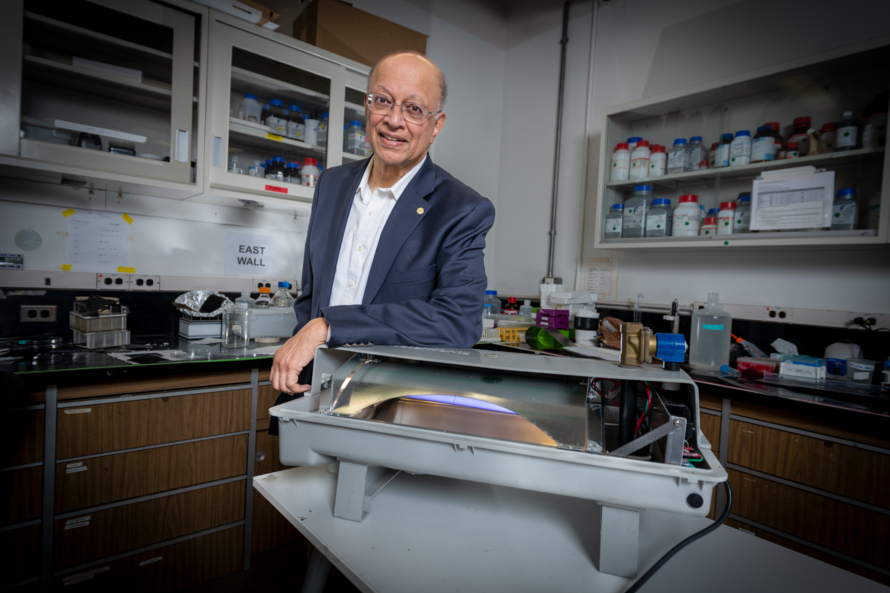
Ashok Gadgil, Physicist Faculty Senior Scientist/Engineer, Energy Technologies Area (ETA), photographed with the UV Waterworks device, a low-cost and efficient water purifier that utilizes ultra-violet light to render viruses and bacteria harmless, at his lab on the UC Berkeley campus. Photo credit: Thor Swift/Berkeley Lab.
Hail’s work is focused on overcoming the limits of today’s high-power laser technology, which is used in fields ranging from advanced manufacturing to optical communications. Existing systems can typically only steer a single laser beam at a time. Hail is developing a new device that can rapidly shape and direct high-power light in far more flexible ways, with the potential to transform numerous manufacturing, directed energy and telecommunications applications.
Previous AIC-Bakar Fellows are already taking on some of the largest energy and climate challenges of our time. One example of this is professor of Electrical Engineering and Computer Science Robert Pilawa-Podgurski, whose group is developing a compact voltage regulator that halves power conversion losses and shrinks physical size by 75%, a breakthrough that has the potential to reduce data center energy consumption by nearly 10%.
Another promising development comes from Zakaria Al Balushi, an assistant professor in Materials Science and Engineering whose team is working on scaling a greener, more efficient method for synthesizing materials such as gallium nitride and ammonia, the production of which alone consumes roughly 3% of the world’s energy.
The 2025 Bakar cohort added equally ambitious projects. Roya Maboudian and Paulo Monteiro, have developed a process that converts concrete waste into high-performance cement in seconds, with the potential to eliminate over a billion tons of CO₂ annually. And Gerbrand Ceder is advancing new materials as a safer, lower-cost alternative to nickel- and cobalt-based lithium-ion batteries. The projects funded through the program span advanced hardware, civic technology, and AI-enabled tools, all of them chosen for their potential to move from the laboratory into real-world use.
Why Berkeley, why now
For Matt and Lisa Sonsini, the decision to invest in academic innovation at UC Berkeley is both deeply personal and rooted in a shared belief about where breakthroughs that change the world come from.
Both Matt and Lisa have built careers at the intersection of innovation, business, and impact. Together, in 2023, they founded the Academic Innovation Catalyst to bring those passions together: catalyzing academic innovation for positive social impact.
They chose to begin at Berkeley because they saw a university uniquely positioned to turn fundamental discoveries into solutions for society’s hardest problems. Berkeley’s strengths in science and engineering, its ranking as the world’s top creator of venture-funded startups, and its public mission to serve the broader good all aligned with what AIC was built to support.
What began as a pilot with the Bakar Fellows Program has since grown into a partnership spanning four UC campuses, multiple academic centers, and a new entrepreneurial hub on the Berkeley campus. With AIC, the Sonsinis are signaling that this is only the beginning.
“Berkeley has the talent, the ideas, and the values,” Lisa Sonsini said. “Our job,” Matt Sonsini added, “is to help unlock what’s already here.”
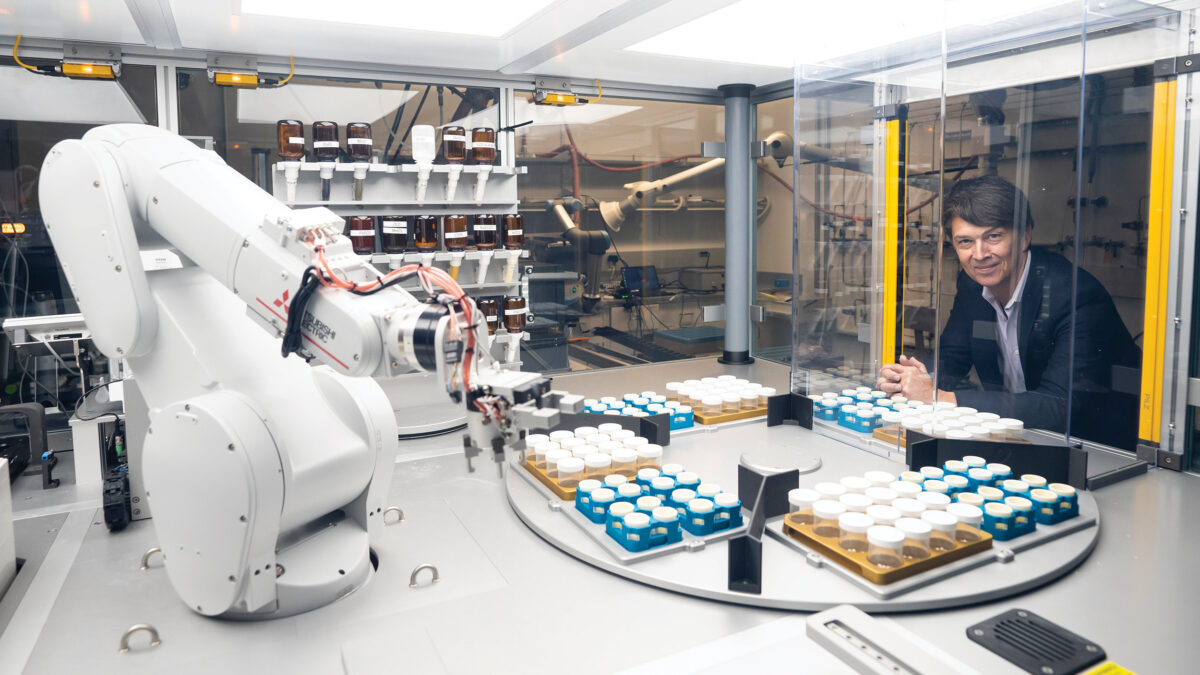
Professor Gerbrand Ceder inside Berkeley Lab's fully automated A-Lab, which uses Al and robotics to synthesize new materials 24/7 without human intervention. Photo credit: Adam Lau/ UC Berkeley Engineering
In 2025, AIC expanded its partnership with CITRIS to include Berkeley’s College of Computing, Data Science, and Society (CDSS). That year, Berkeley researcher Xiaoyu (Rayne) Zheng was one of five awardees recognized through the CITRIS-CDSS Innovation Fellowships for his work developing Desktop Electronics Projection Lithography (DEPL), a rapid, low-cost fabrication method for producing fully 3D electronic structures with nanoscale conductive precision. Also among the 2025 awardees was Berkeley researcher Greg Tikhomirov, whose work focuses on developing precisely engineered nanoscale structures for the targeted delivery of mRNA vaccines and therapeutics, with potential applications ranging from infectious disease prevention to the treatment of cancer and other complex diseases.
In the inaugural 2024–25 cycle, the awards recognized three faculty innovators, including UC Merced researcher Reza Ehsani, who is developing a sensor clip for fast, cost-effective monitoring of plant water status designed to help farmers use water more efficiently in an era of intensifying drought.
A widening partnership with Berkeley
None of this work would be possible without philanthropy. Every dollar of AIC funding, from the awards faculty receive to the staff who run the programs to the new entrepreneurial center taking shape on campus, is made possible by the generosity of donors who believe in Berkeley’s public mission. The couple’s latest commitment stands among the most significant of those investments, and it reflects a partnership that has steadily deepened over the past several years.
Both Berkeley alums, Matt and Lisa have been longtime supporters of the university’s mission, and their newest gift reinforces a partnership the Chancellor has called a model for how philanthropy and public research can work together.
The gift also arrives at a moment of momentum for Berkeley’s innovation and entrepreneurship ecosystem, which Pitchbook has ranked the world’s number-one creator of venture-funded startups. With AIC, that ecosystem gains a new on-ramp specifically designed for the deepest, most ambitious research, the kind that takes years to mature but holds the greatest potential to change the world.
“Our hope is simple,” Matt Sonsini said. “We want to help unleash practical innovation for the public good. Berkeley is exactly the place to do it.”


